
China’s Quiet Conquest:
Jensen Huang’s AI prophecy has come true

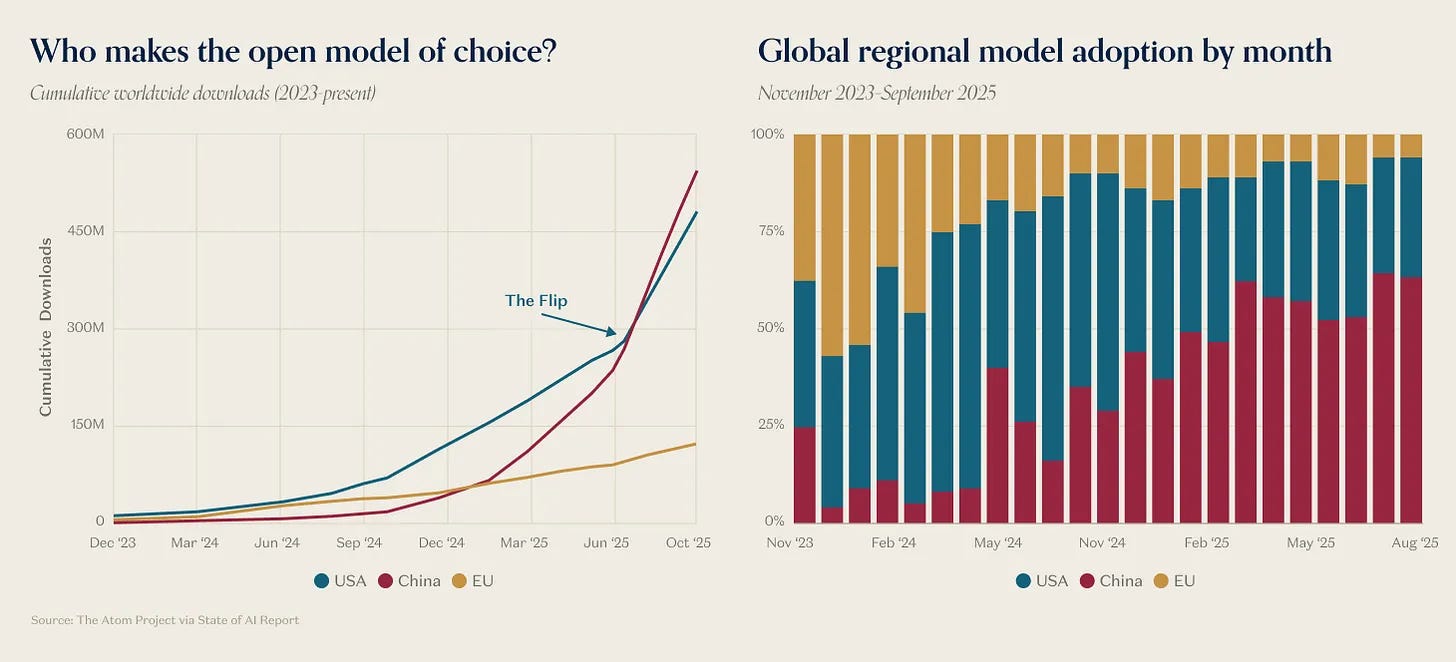
When the visionary chief of Nvidia, Jensen Huang, declared that “China is going to win the AI race”, the remark landed on President Trump’s desk the same day. Coming from the man whose graphics processors power the world’s most voracious AI models, it was no mere provocation. It was a dire warning. In an era when the West obsesses over the glamour of algorithms and the spectacle of frontier labs, Huang’s insight pierces to the prosaic foundations of power: the unyielding grind of supply chains, the relentless march of infrastructure, and the subtle weave of diplomacy. As US-China rivalry intensifies, his words increasingly ring true. China is not merely competing in the AI race; it is redefining the track, the terrain and the rules of endurance.
At the heart of this ascent lies an asymmetry the West too often dismisses as mundane: control over the material sinews of computation. China processes 90% of the world’s rare earth minerals and the elemental alchemy that transmutes raw minerals into the magnets and alloys essential for AI hardware. China’s 5N (99.999%) refined products hold sway over semiconductor assembly, printed circuit board fabrication, and device manufacturing—the backbone of GPUs, servers, and edge devices that make AI not just possible, but scalable.
Far from being an accident of geology or happenstance of history, it is the fruit of deliberate industrial policy, honed over decades. Where the US frets over export bans and reshoring fantasies, China’s grip ensures a stable, predictable flow of inputs. Disruptions, whether from geopolitical spats or market whims, barely ripple through its fortress of vertical integration.
This end-to-end mastery translates into a temporal edge that’s almost unfair, thanks to clusters of highly coordinated suppliers, a coordination that lets China absorb setbacks like US chip curbs and pivot with predatory speed. Huang, whose empire depends on this same hardware heartbeat in Taiwan, sees the implications clearly: in AI, data devours compute and compute devours chips, time is not just money—it is supremacy. But supply chains alone do not win races; they merely set the pace. China’s true audacity reveals itself in the audacious scale of its infrastructure. The country is erecting a National Integrated Computing Network, a sprawling web to pool resources across public and private data centres. Imagine a neural lattice spanning provinces, dynamically allocating exaflops of processing power to whoever—or whatever—needs it most. This is not incrementalism; it is a foundational bet on compute as the new oil.
By 2030, Beijing aims to host 30% of the world’s data centre capacity, dwarfing the US’s fragmented grid. Powering it? A cascade of renewables and nuclear plants that sidestep the West’s permitting quagmires. In a field where training a single large language model can consume the energy of a small town, China’s foresight in energy sovereignty turns potential bottlenecks into accelerators.
But, again, hardware and horsepower are blunt instruments without the finesse of alliances. Here, Beijing’s strategy shines with the subtlety of a Confucian diplomat. It is simultaneously deepening trade ties with ASEAN, Africa, and Latin America, weaving a tapestry of FTAs that buffers against US pressure. The RCEP, already the world’s largest trade bloc, serves as a bulwark, while bilateral pacts with Brazil and Indonesia secure raw materials and markets. This is not mere mercantilism; it is a recalibration of the global order. As Washington wields tariffs like a bludgeon, Beijing offers partnerships laced with infrastructure loans and tech transfers.
The Global South, weary of Western threats and lectures, finds in China a pragmatic patron. By 2025, Belt and Road investments have already locked in 150 countries, ensuring a reservoir of goodwill—and data—that no American sanctions can drain. Underpinning this edifice is a doctrine of technological self-reliance, enshrined in the 14th Five-Year Plan and soon to be amplified in its 2026–2030 successor. “High-quality development” is the mantra, a euphemism for slashing US tech imports while igniting domestic innovation.
Huawei’s ascent from sanctions-hit pariah to 5G titan exemplifies the resilience: by 2025, China’s chip self-sufficiency has climbed from 15% for advanced nodes a decade ago to 70 % today. As US elections swing like pendulums and European coalitions fracture, Beijing remains the responsible stabilizer—in an age of chaos, underscoring why Huang’s prophecy feels inexorable. With its unyielding grip on the essentials and its patient orchestration of the rest, China, is not just running—it is reshaping the course.
Case study
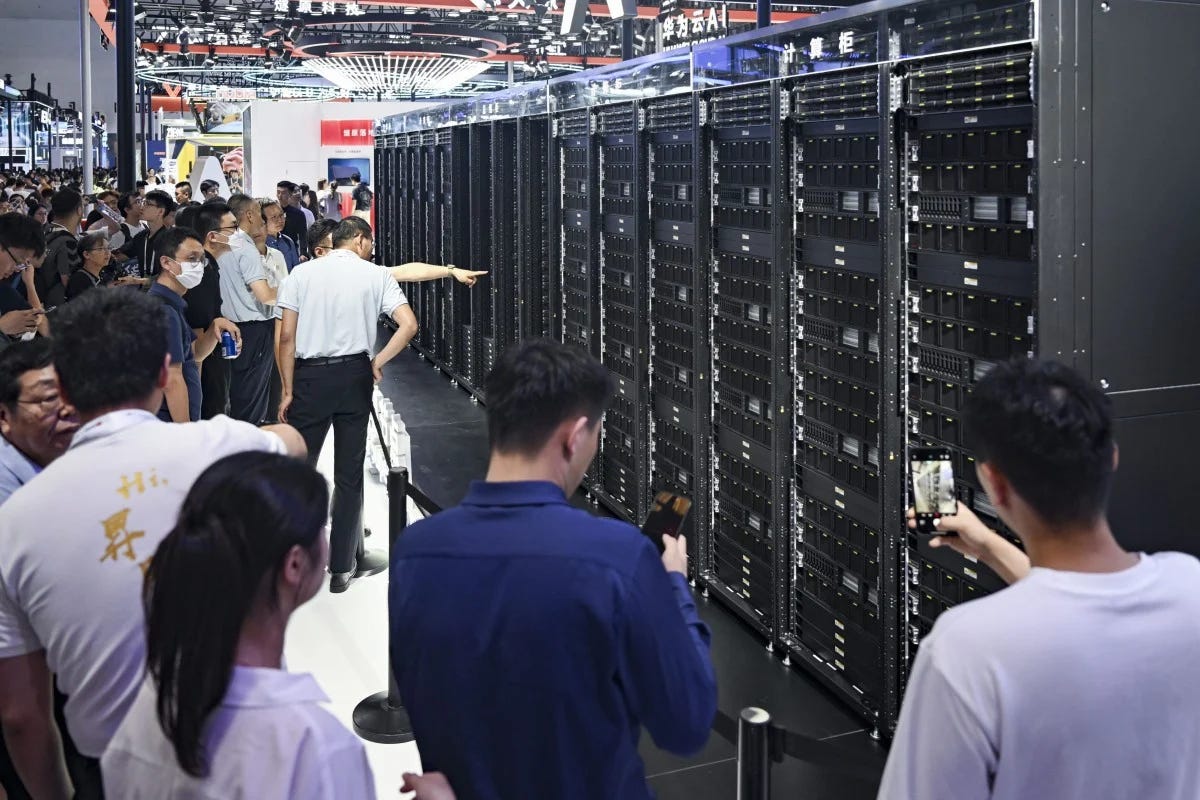
Huawei’s CloudMatrix 384 AI supercomputer, above, gives 300 petaflops in half-precision math (1.7x more than Nvidia), 49.2 TB high-bandwidth memory (3.6x Nvidia), and 1,229 TB/s memory bandwidth (2.1x Nvidia), with 2.1x more scale-up bandwidth and 5.3x scale-out bandwidth than Nvidia.
China CAPEX is only 10% of US , yet China-AI performance is virtually “on par” to US-AI